
The death toll in the massive flash floods in Nepal on Thursday rose to 270, as authorities in Nepal race against time to find thousands of missing people, including 288 Indian tourists, in one of the country's worst disasters in recent years.

European football's governing body, UEFA, announced a moment of silence and a solidarity banner at all Champions League matches this week to support victims of devastating flash floods in Nepal, where the death toll has risen and thousands remain missing.

Several pilgrims from Tamil Nadu, including Ilavarasi and Chitra, have gone missing in Nepal following devastating flash floods, leaving their families distraught and appealing for urgent government rescue efforts.

A senior Geological Survey of India official warns that the Himalayas are vulnerable to cascading disasters, where one high-altitude event can trigger a chain of destructive events downstream, as evidenced by Nepal's recent floods. He stresses the need for integrated monitoring using satellite data and ground investigations to identify high-risk areas and improve preparedness in the Indian Himalayas.

Devastating flash floods in Nepal's Bhote Koshi River, triggered by a glacier or ice rock collapse, have resulted in 175 recovered bodies and hundreds missing, including tourists. India has promptly responded by providing 10 tons of humanitarian aid and medical supplies, with Prime Minister Narendra Modi conveying condolences and assuring full support to Nepal.

The devastating flash floods wreaked havoc across Nepal, with the ministry of external affairs on Thursday stating that 84 Indian nationals have been rescued while 290 remain uncontactable as the Himalayan nation stepped up search, rescue and relief operations following the disaster that has claimed more than 390 lives.

The death toll from devastating flash floods in Nepal has surged to 1,252, with more bodies recovered and fresh flood risks emerging due to continuous rainfall in the Bhotekoshi River's upstream areas. The disaster, triggered by an ice-rock avalanche, has also left 4,875 people missing and prompted calls to address climate change's impact on the Himalayan region.

Nepal is reeling from devastating flash floods that have claimed over 600 lives and left more than 2,400 people missing. Rescuers are battling difficult conditions, including intermittent rainfall, to find survivors, while families desperately search for loved ones among lists of the injured and deceased. The widespread destruction has left towns and villages buried under mud, with infrastructure severely damaged.

The death toll from devastating flash floods in Nepal has tragically risen to 903, with 4,247 people still reported missing, including security personnel and foreigners. India has dispatched an 18-member team of forensic experts to assist with DNA analysis and identification of victims.

China on Friday said the collapse of a high-altitude glacier in Nepal may have triggered the massive flash flood disaster that engulfed the Tibet-Nepal border, killing hundreds and causing widespread damage.

Images emerging from Nepal show the extent of destruction caused by the massive flash flood that swept through the Bhote Koshi and Trishuli river corridors, with houses, roads and bridges destroyed and large areas covered with mud, rocks and debris.

Nepal has launched a diplomatic initiative to secure climate-related compensation from major greenhouse gas emitters, asserting that post-disaster assistance for recent deadly flash floods should be viewed as a moral and legal liability, not charity. Foreign Minister Shisir Khanal highlighted Nepal's disproportionate suffering from global warming despite negligible emissions, citing rapid glacier melt and extreme mountain disasters. The country has formally approached the Loss and Damage Fund board for urgent financial aid following a catastrophic flash flood in the Bhotekoshi river basin.

Nepal is grappling with the devastating aftermath of flash floods, with the death toll reaching 1,356 and nearly 5,000 people, including foreign nationals, still missing. Identification of bodies is a major challenge, with only a fraction identified so far. President Ramchandra Paudel has appealed for climate justice and national unity for relief efforts. International teams, including experts from India and China, are assisting in search and rescue, particularly at hydropower projects where workers are trapped. The country is also working to restore infrastructure and reassure tourists to protect its vital autumn tourism season.

Nepal's devastating flash floods have claimed 1,127 lives, with thousands still missing a week after the disaster. Rescuers are intensifying efforts to find survivors and recover bodies across affected regions, while police work to identify victims and relocate families from high-risk areas.

Scenes from the aftermath of Nepal's devastating flash flood, August 27, 2026. Drone images reveal mud-covered towns while Nepalese army rescue teams race to save stranded residents after the Bhotekoshi river outburst.

'In the wake of this tragedy, India will provide power to Nepal if and when the requirement for the same is communicated to India as per their needs.'

The August 26, 2026 flash flood and mudslides devastated Nepal, leaving homes destroyed, families grieving, and thousands unaccounted for.'Drone views reveal mud-covered villages while survivors search for belongings and mourn loved ones. Relief operations continue as military and police forces airlift survivors, transport victims, and assist communities in the aftermath of the disaster.

An 11-member Indian team, including medical and tunnel-rescue specialists, has arrived in Nepal to assist in the rescue of workers trapped in hydropower project tunnels following devastating flash floods. The disaster has killed hundreds, left thousands missing, and damaged critical infrastructure, prompting Nepal to seek international aid for rescue and reconstruction.

Hundreds of people are desperately searching for missing family members and friends outside hospitals in Nepal, as devastating flash floods have killed at least 270 people and left 826, including 476 foreigners, reported missing.

Eleven days after devastating floods triggered by an ice-rock avalanche, Nepal continues to grapple with a rising death toll of 1,344 and nearly 5,000 missing. Authorities face significant challenges in identifying the deceased, with many bodies severely damaged. DNA samples are being collected from relatives to aid identification, while the government mobilises relief and rehabilitation efforts. A fresh flood incident in Gorkha district also caused damage.

Following devastating floods in Nepal, Kathmandu has initiated mass burials for unidentified victims as morgues have exceeded capacity. Security forces are burying bodies with markers and collecting DNA samples for future identification. The government has amended the Unidentified and Unclaimed Bodies Management Guidelines, 2021, to facilitate the management of disaster victims, including provisions for autopsies, DNA collection, and temporary burial with identification markers.

Climate scientist Tapio Schneider advocates for expanding early warning systems beyond rainfall events to include other disaster triggers like flash floods, citing the recent Nepal floods. He highlights the inevitability of 1.5 degrees Celsius global warming and discusses the role of advanced climate modelling and AI in improving predictions and research, particularly for regions like India.

A recent study by scientists indicates that the Hindu Kush-Himalaya region is experiencing increased frequency and intensity of extreme weather events due to climate change, including rapid glacial melting and changing rainfall patterns. However, the research also cautions against solely blaming climate change, highlighting that human factors like population growth, commercial activities, and non-enforcement of regulations contribute significantly to the vulnerability and impact of these disasters. The study points out that many devastating floods originate from small glaciers and rain-fed streams, exacerbated by encroachment on unstable slopes and floodplains.

Heavy rainfall and high speed wind has badly affected normal life in Bihar in last 24 hours because of cyclonic storm Phailin impact of cyclonic storm. "More heavy rains are expected in Bihar in next 24 hours," a met department official said.
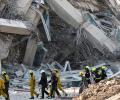
The earthquake rocked many parts of Thailand including its capital Bangkok, the venue for next week's summit of BIMSTEC regional grouping that is scheduled to be attended by Modi among other leaders.

With many searching their loved ones after the Nepal earthquake, Google has launched its 'person finder' tool and Facebook has activated its 'safety check' feature to help locate and report missing persons.

'In the last 55 years India and Pakistan have gone to wars, but nobody spoke about scrapping the Indus Waters Treaty.'
